
How to Identify Anonymous Website Visitors Systematically
Most of your website visitors leave without a trace. Here is a systematic way to identify who they are, what they want, and when to reach them.


TL;DR
Quick Summary
Listen to summary
0:00 audio overview
Quick Answer
Someone just spent eleven minutes on your pricing page. They read your case studies. They clicked back to compare two of your service tiers.
Then they left.
You have no idea who they were.
This is not an edge case. It is the default state of most B2B websites. The visitors who are most interested in buying are often the ones who leave no trace. They are researching quietly, building an internal case, deciding whether to contact you at all.
Knowing how to identify anonymous website visitors is not a nice-to-have. It is a core part of building a pipeline you can actually predict.
Why Most Visitors Stay Anonymous
Your website was probably built to attract people and convert them through forms. Someone fills out a contact form, and your CRM knows who they are. That part works.
The problem is that most visitors never fill out a form. They browse, evaluate, and disappear. In B2B, that gap is significant. Multiple people inside one company may be researching you at the same time, none of them ready to raise their hand.
So your analytics shows you traffic volume and page views. But it cannot tell you which company just looked at your enterprise pricing page three times this week.
That is the identification problem. And it is solvable, systematically.
What Visitor Identification Actually Means
Before you buy any tool, get clear on what you are trying to do.
Visitor identification is the process of connecting an anonymous website session to a real person, a real company, or both. There are two distinct levels:
Company-level identification tells you which organization is on your site. This uses IP-to-company resolution. It is imprecise, but useful. You learn that a company in your target market visited your site, what they looked at, and for how long. This is the foundation of account-based marketing.
Contact-level identification goes further. It matches a visitor to an actual person, usually using a combination of first-party cookies, email pixel data, and third-party identity graphs. This is more powerful and more regulated. It requires careful attention to privacy law.
Most businesses start at the company level and move up from there as their processes mature. That is the right sequence.
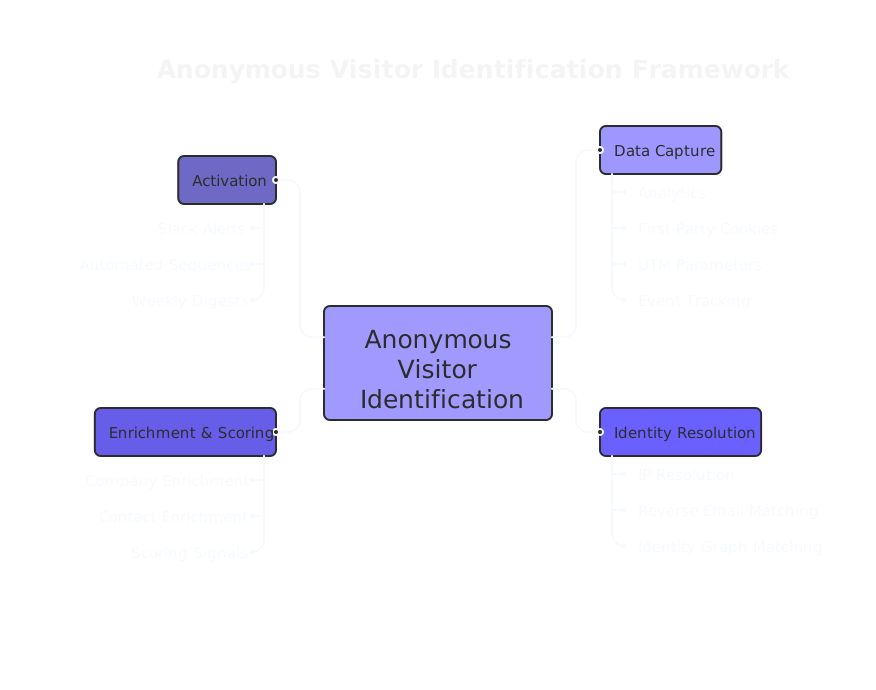
The Systematic Approach: Four Layers
The biggest gap in how most teams think about visitor identification is that they treat it as a tool purchase rather than a process. They buy a platform, get a list of company names, and then wonder why nothing changes in their pipeline.
The systematic approach treats identification as a four-layer operation.
Layer 1: Data Capture
You cannot identify what you do not capture. This means your website needs to be instrumented correctly before you add any identification tool.
That includes:
- A properly configured analytics platform that respects consent requirements
- First-party cookies set on your own domain, not third-party
- UTM parameters that follow visitors from ad click to page view
- Event tracking on key behaviors: pricing views, demo requests, content downloads
If your tracking setup is inconsistent, your identification data will be inconsistent. Garbage in, garbage out.
Layer 2: Identity Resolution
This is where you match an anonymous session to a known entity. There are three main methods:
IP resolution maps a visitor's IP address to a company name. Tools like Clearbit, Dealfront, and Factors.ai do this. It works well for larger companies with static IP ranges. It struggles with remote workers, VPNs, and smaller organizations.
Reverse email matching works when a visitor has previously clicked an email you sent them. The link contains an identifier that connects their browser session to their email address in your CRM. This is highly accurate for people already in your database.
Identity graph matching uses large third-party databases to match browser fingerprints, device IDs, or hashed emails to contact records. This is what tools like RB2B and Customers.ai use. It is powerful but requires transparency with your audience and compliance with applicable privacy rules.
No single method covers everyone. A systematic approach uses more than one.
Layer 3: Enrichment and Scoring
Once you know who is visiting, you need to know what to do with that information.
Enrichment adds context. A company name becomes an account record with industry, size, revenue range, and tech stack. A contact becomes a profile with job title, seniority, and department.
Scoring tells you which visitors matter most right now. Not every anonymous visitor is a sales opportunity. A systematic scoring model weighs:
- Fit: Does this company match your ideal customer profile?
- Behavior: Did they visit high-intent pages like pricing or case studies?
- Frequency: Have they been back multiple times?
- Recency: Did this happen in the last 48 hours?
A visitor who hits all four signals is worth an immediate response. A visitor who hits one is worth adding to a nurture sequence. The score drives the action.
Layer 4: Activation
Data that sits in a dashboard is not pipeline. Activation is where most teams fail.
Activation means routing the right information to the right person at the right time. For a B2B sales team, that might mean:
- A Slack alert when a named target account visits your pricing page
- An automated sequence that starts when a new company matches your ICP and views three or more pages
- A weekly digest for your account executives showing which of their open opportunities visited the site
The activation step requires integration between your identification tool, your CRM, and your communication channels. This is not complex to build, but it does require intentional setup. It does not happen automatically when you install a tracking pixel.
A Real Scenario That Shows Why This Matters
Consider a consulting firm that runs paid search campaigns. Their ads drive hundreds of clicks per week. Their form fill rate is under two percent.
Without visitor identification, they see clicks and spend but cannot connect them to specific companies. They optimize for click-through rate because that is what they can measure.
With IP resolution and behavioral scoring, they can see that twelve of their target accounts visited their site in the past thirty days without converting. They know which pages those accounts viewed and for how long. Their sales team reaches out with relevant context instead of cold openers.
The insight changes not just their outreach strategy but also their content priorities. They realize that one specific service page is getting high engagement from companies that never convert. That page becomes a focus for conversion rate improvement.
The data does not just find leads. It improves the entire funnel.
What to Look for in a Visitor Identification Tool
There are dozens of tools in this category. The right one depends on your situation. Here is what actually matters:
Match rate and data quality. Ask any vendor for their average match rate for companies like yours. A tool with a 30% match rate on your audience is not the same as one with a 70% match rate. Request a proof of concept before you commit.
Privacy compliance. Visitor identification sits at the edge of privacy law. GDPR, CCPA, and similar regulations apply. Make sure the tool you choose handles consent correctly and can provide documentation of their data practices.
Integration depth. Can it send data directly to your CRM? Can it trigger workflows in your marketing automation platform? A tool that only lives in its own dashboard will not change your pipeline.
Actionability of output. Does it give you company names only, or can it surface contact-level data? Can you filter by ICP criteria? Can you set up alerts? The best tools are built around action, not reporting.
Common Mistakes to Avoid
Buying identification before fixing your tracking. If your base analytics setup is broken, a visitor identification tool will amplify the chaos, not solve it.
Treating all identified visitors equally. A Fortune 500 that does not match your ICP is less valuable than a mid-market company that matches perfectly and visited your pricing page twice. Score before you route.
Skipping the CRM integration. The output of your identification system needs to live where your sales team works. If your team has to log into a separate platform to see the data, they will not use it.
Ignoring the privacy layer. Some identification methods require explicit consent. Others operate in gray areas that are shifting as regulations evolve. Build with privacy in mind from the start, not as an afterthought.
How to Identify Anonymous Website Visitors: A Quick-Start Checklist
If you want a clear starting point, work through these steps in order:
- Audit your current tracking setup. Fix broken tags and confirm your analytics is capturing sessions accurately.
- Define your ideal customer profile clearly. You need this before you can score visitors effectively.
- Choose an IP resolution tool that matches your market. Test it on a sample of your existing traffic.
- Connect it to your CRM and set up basic alerting for high-fit, high-intent visitors.
- Build a simple scoring model using fit plus behavioral signals.
- Create an activation workflow for your top-scoring visitors.
- Review the data weekly and adjust your scoring weights based on what is actually converting.
This is not a one-time project. It is an ongoing process that gets sharper over time.
The Bigger Picture
Visitor identification is one piece of a larger first-party data strategy. The companies that do this well are not just finding anonymous visitors. They are building a systematic understanding of how buyers move through their market, long before those buyers ever fill out a form.
That changes how you write content. It changes how you allocate ad spend. It changes which sales conversations you prioritize.
At House of MarTech, we help B2B businesses build these systems end to end. From tracking audits and tool selection to CRM integration and activation workflows. The goal is always the same: turn data you are already generating into decisions that move revenue.
If you are ready to build a visitor identification system that actually connects to your pipeline, the right place to start is a conversation about your current setup. Not a tool demo. A real look at where your data is today and where it needs to go.
That is the kind of work we do at House of MarTech.
Frequently Asked Questions
Get answers to common questions about this topic
Have more questions? We're here to help you succeed with your MarTech strategy. Get in touch
Related Articles
Need Help Implementing?
Get expert guidance on your MarTech strategy and implementation.
Get Free Audit