
Segmentation & Personalisation: The Systematic Approach That Actually Works
Most segmentation fails before it starts. Here is how to build a systematic approach to segmentation and personalisation that drives real revenue, fixes data silos, and scales without breaking.


TL;DR
Quick Summary
Listen to summary
0:00 audio overview
Quick Answer
Most marketing teams have a segmentation problem they have not named yet.
They have data. They have tools. They even have segments. What they do not have is a system that connects those three things into consistent, personalised experiences that customers actually notice.
That gap is not a technology problem. It is a process problem. And it costs real money.
This post is about fixing it. Systematically.
Why Most Segmentation Fails Before It Starts
Here is what typically happens. A marketing team builds segments based on what is easy to pull, not what is meaningful to customers. Age range. Country. Subscription tier. Those are fine starting points. But they rarely reflect how a customer actually behaves, what they want next, or when they are ready to buy.
A retail brand might segment by "customers who bought in the last 90 days" and send the same email to someone who bought once at a discount and someone who buys every month at full price. Same segment. Completely different value. Completely different message needed.
The result is generic messaging dressed up as personalisation. Customers see through it immediately.
The fix is not more segments. It is better criteria for building them.
What Is Segmentation and Personalisation, Really?
Segmentation is the process of dividing your customer base into groups that share meaningful characteristics. Personalisation is what you do with those groups, tailoring the message, timing, and channel to fit each one.
They are not the same thing, but they depend on each other. Segmentation without personalisation is just a list. Personalisation without segmentation is just a guess.
Together, they form the foundation of any serious data-driven marketing approach.
Common segmentation types include:
- Demographic: Age, location, income, job title
- Behavioural: Purchase frequency, browsing patterns, email engagement
- Lifecycle stage: New customer, repeat buyer, at-risk, lapsed
- Predictive: Likelihood to churn, predicted next purchase, lifetime value tier
The most powerful segmentation combines two or more of these. A customer who is high-frequency, high-value, and showing early churn signals needs a completely different campaign than a new customer who just made their first purchase.
The Real Barrier: Data That Does Not Talk to Itself
You already know data silos are a problem. But here is the part that does not get said enough: most teams do not fix the silo, they work around it.
They export from one tool, manually match it in a spreadsheet, and upload it to another. That process is slow, error-prone, and impossible to scale. And it means your segments are always slightly out of date.
The Adobe CDP Institute has noted that data silos are one of the primary barriers to real-time personalisation. That finding tracks with what we see regularly. The technology is rarely the bottleneck. The architecture behind it is.
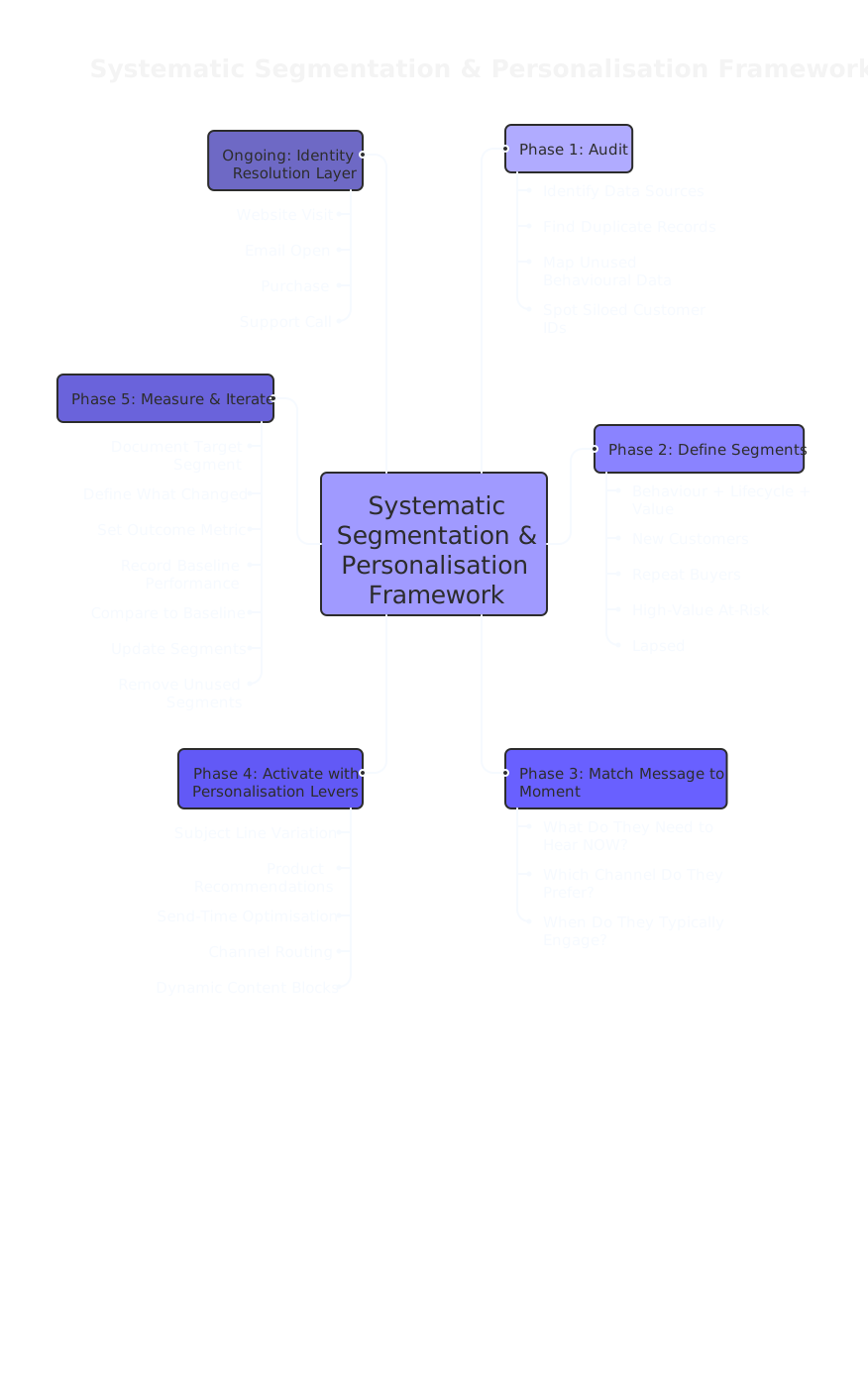
Identity resolution is the part of the solution that does not get enough attention. When a customer visits your site, opens your email, and then calls your support line, those three events often live in three separate systems with three different identifiers. Identity resolution stitches those records together into one coherent profile.
Once you have that unified profile, segmentation becomes more accurate. And when segmentation is more accurate, personalisation actually lands.
If your current stack does not support identity resolution, that is worth addressing before you invest further in personalisation tooling. At House of MarTech, a significant part of our integration work involves helping teams build this connective layer so their existing tools can finally do what they were bought to do.
A Systematic Approach to Segmentation and Personalisation
There is no shortage of advice on segmentation tactics. What is harder to find is a clear sequence for building the whole system. Here is how to think about it.
Step 1: Audit What You Already Have
Before you add anything new, understand what you are working with. What data are you collecting? Where does it live? What does it tell you about customer behaviour, and what gaps exist?
This is not glamorous work. But skipping it means building on an unstable foundation.
Look specifically for:
- Duplicate customer records across systems
- Behavioural data that is collected but never activated
- Segments that were built once and never updated
- Channels that operate on different customer records
Step 2: Define Segments Around Decisions, Not Demographics
Ask yourself: what decision does this segment help me make? If the answer is vague, the segment is too broad.
A segment called "UK customers aged 25 to 44" does not help you decide what to say or when to say it. A segment called "UK customers who purchased twice in the last six months but have not opened an email in 60 days" tells you exactly who needs a re-engagement campaign and why.
Build segments that drive action. Every segment should map directly to a campaign, a message variation, or a channel decision.
Step 3: Match Message to Moment
The timing and channel of a message matter as much as the content. A personalised message sent at the wrong time or through the wrong channel performs no better than a generic one.
Klaviyo's research on send-time optimisation shows that personalising the time an email is sent, based on when an individual customer has historically engaged, can meaningfully improve open rates. That is a small but real example of what it looks like to match message to moment at scale.
Think about each segment in terms of three questions:
- What does this person need to hear right now?
- Where are they most likely to engage?
- When have they historically responded?
Step 4: Build for Iteration, Not Perfection
The biggest implementation mistake is treating segmentation as a one-time project. It is not. Customer behaviour changes. Campaigns run. Segments need to be refreshed.
Build a review cadence into your process. Monthly is a reasonable starting point for most teams. Review which segments are growing, which are shrinking, and which campaigns tied to those segments are performing.
If a segment has not driven a campaign decision in three months, either activate it or remove it. Dead segments create clutter and slow everything down.
Personalisation at Scale: What That Actually Means
Personalisation at scale does not mean sending 100,000 unique messages. That is neither practical nor necessary.
It means identifying the meaningful variation points in your customer base and building content that adapts to those variations. Usually, four to six well-defined segments with distinct messaging outperforms fifty micro-segments with inconsistent execution.
Adobe's guidance on orchestrating personalisation at scale emphasises harmonising four things: the right data, the right content, the right channel, and the right timing. That is a useful frame. When one of those four is off, the whole experience feels generic even if the others are right.
Practical personalisation levers for most teams include:
- Subject line variation based on purchase history or lifecycle stage
- Product recommendations driven by behavioural data, not just purchase history
- Send-time personalisation based on individual engagement patterns
- Channel preference routing so high-value customers get SMS or push, not just email
- Dynamic content blocks in email or on-site that swap based on segment membership
You do not need all five at once. Start with the one that addresses the biggest gap in your current experience. Build from there.
We have covered how to implement dynamic content systematically in a previous House of MarTech post on personalised dynamic content. If your content is still static across segments, that is a good place to start.
The Measurement Problem Nobody Talks About
You can build great segments and run thoughtful personalised campaigns and still not know if any of it is working. That happens when measurement is an afterthought.
Every segment-driven campaign needs a baseline and a comparison point. That does not require a complex attribution model. It requires discipline.
Before you run a personalised campaign, document:
- What segment you are targeting
- What you changed compared to your default message
- What outcome you are measuring
- What the baseline performance looks like
After the campaign, review against those four points. Over time, you build an evidence base for what your specific audience responds to. That is more valuable than any benchmark from an industry report.
If attribution is a gap in your current setup, that is worth addressing separately. We have written about driving direct revenue through segmented marketing and how to connect campaign activity to revenue outcomes in a way that does not require a data science team.
Common Questions About Segmentation and Personalisation
How many segments should I have?
Start with fewer than you think you need. Three to five well-defined segments with clear activation paths beat twenty segments that never get used. Add more only when you have campaigns ready to match them.
What data do I actually need to start?
Email engagement history, purchase frequency, and lifecycle stage will get you further than most teams realise. You do not need a full customer data platform to do meaningful segmentation. You need clean data and a clear decision framework.
What is the difference between segmentation and a customer data platform?
Segmentation is a strategy. A customer data platform (CDP) is a tool that can support it. A CDP helps you unify customer data from multiple sources and activate it across channels. But segmentation can be done without one. The strategy comes first.
How often should I update my segments?
At minimum, quarterly. Monthly if your campaigns are running continuously. Any segment based on time-sensitive behaviour, like recent purchasers or at-risk customers, should refresh automatically in your platform, not manually on a schedule.
What Good Looks Like
A business owner we spoke with ran a mid-size e-commerce brand selling specialty food products. They had email, SMS, and a loyalty programme, but all three were running independently with no shared customer view.
Their "personalisation" was putting the customer's first name in the subject line.
After mapping their customer data, they identified four clear segments: first-time buyers, repeat buyers on a regular cadence, high-value customers who had gone quiet, and lapsed customers. They built distinct email sequences for each and connected their loyalty data to trigger SMS for the high-value segment.
Within two months, their re-engagement campaign for the quiet high-value group was outperforming their standard broadcast by a significant margin. Not because the writing was better. Because the message was relevant to the moment the customer was actually in.
That is what systematic segmentation and personalisation looks like in practice.
Where to Go From Here
If you are just starting out, the priority order is simple:
- Audit your current data and identify where gaps and duplicates live
- Define three to five segments based on behaviour and lifecycle stage
- Map each segment to a specific campaign or message variation
- Measure against a baseline before you optimise anything
If you already have segments in place but results are flat, the issue is usually one of three things: segments that do not reflect real behaviour, messaging that is not differentiated enough, or measurement that does not capture the right signal. Each of those is fixable.
If you want a second set of eyes on your current setup, House of MarTech works with business owners to assess segmentation strategy and identify where the biggest gains are hiding. Sometimes the answer is a technology fix. Often it is a process one.
Either way, the work is worth doing. The difference between a generic campaign and a well-segmented, personalised one is not just open rates. It is whether your customers feel like you understand them. And that feeling compounds over time.
House of MarTech is a marketing technology consultancy helping business owners build smarter, more connected marketing systems. If segmentation and personalisation is a priority for your team this year, get in touch and we will help you figure out where to start.
Frequently Asked Questions
Get answers to common questions about this topic
Have more questions? We're here to help you succeed with your MarTech strategy. Get in touch
Related Articles
Marketing Mix Modeling vs Multi-Touch Attribution: Privacy-First Measurement Framework for 2026
Agentic AI for Marketing Operations: How Autonomous Agents Are Reshaping Campaign Execution in 2026
Multi-Touch Attribution Modeling in 2026: Comparing Algorithmic, Time-Decay, and Position-Based Models with Real Data
Need Help Implementing?
Get expert guidance on your MarTech strategy and implementation.
Get Free Audit