
Systematic MarTech Success Framework 2026
Master MarTech success in 2026 with systematic tips, tricks, and insights. Cut stack sprawl, align data to outcomes, and build decision frameworks that drive revenue—not tools.


TL;DR
Quick Summary
Listen to summary
0:00 audio overview
Systematic MarTech Success Framework 2026
Quick Answer
Most marketing technology problems are not tool problems. They are thinking problems.
You buy a new platform. You connect it to three others. You hire someone to manage it. Six months later, you still cannot tell your CEO which campaigns are driving revenue. The tools are working. The system is not.
That is the gap most MarTech advice fails to address. It tells you what to buy. It rarely tells you how to think.
This post gives you the actionable tips, tricks, and insights for MarTech success that actually matter in 2026. Not a shopping list. A decision system.
The Real Problem with Most MarTech Stacks
Here is an honest observation: the average business does not have a tool shortage. It has a clarity shortage.
Stack sprawl is real. According to the Martech Alliance and years of practitioner reporting, most marketing teams use only a fraction of what their tools can do. They pay for capability they never activate. They generate data they never act on.
The tools are not the villain. The missing link is a systematic approach that connects what your tools collect to what your business actually needs to decide.
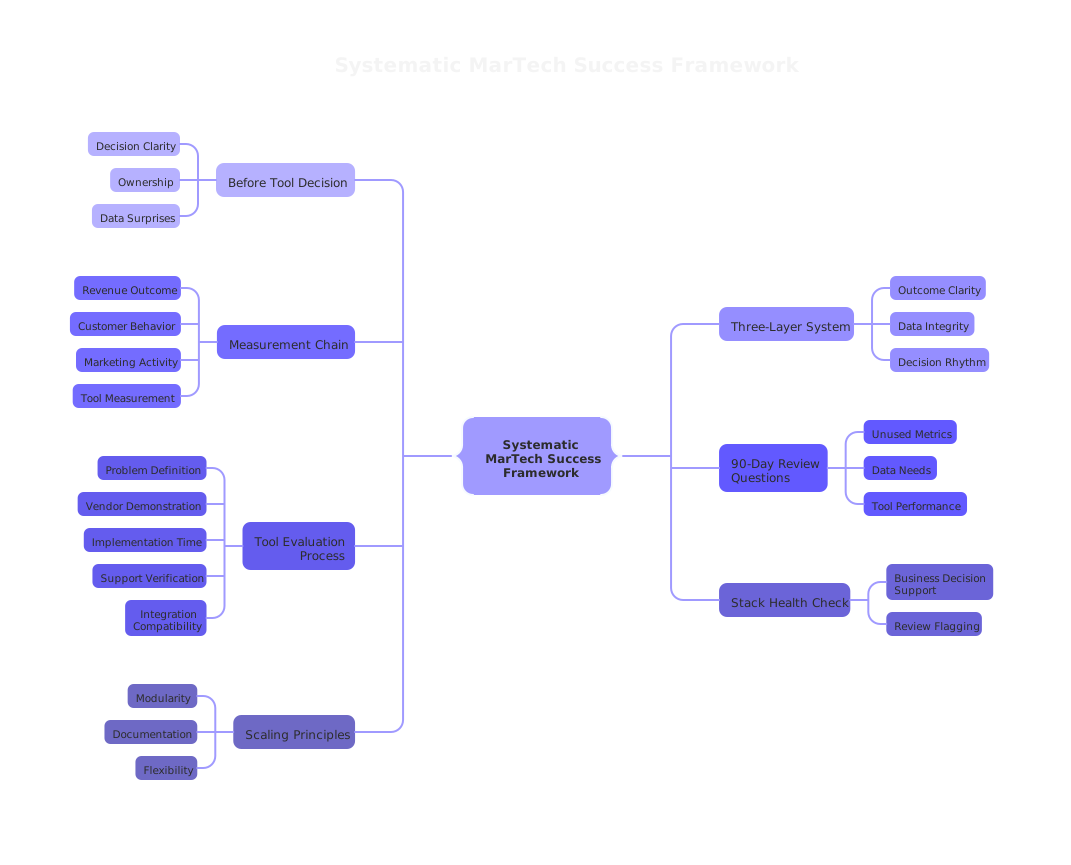
Before you add anything to your stack, before you cut anything, you need to answer three questions:
- What decision does this tool help me make?
- Who owns that decision?
- What happens when the data tells us something we did not expect?
If you cannot answer all three, you are not ready to buy or cut anything yet.
What a Systematic MarTech Approach Actually Looks Like
Systematic does not mean complicated. It means intentional.
A systematic MarTech approach has three layers working together.
Layer 1: Outcome clarity. You know what business result you are building toward. Not "better marketing." Something specific. Revenue from new customers. Shorter sales cycles. Higher retention rates.
Layer 2: Data integrity. Your tools are collecting accurate, consistent data that connects to those outcomes. Not just traffic and clicks. Signals that matter.
Layer 3: Decision rhythm. You have a regular cadence for reviewing what the data says and making changes. Weekly, monthly, quarterly. Someone is accountable for that review.
Most stacks have fragments of all three. What they lack is the connection between them. That connection is what makes a stack perform like a system instead of a collection of subscriptions.
Actionable Tips for MarTech Success in 2026
These are not theories. Each one is something you can apply this week.
1. Start with the outcome, not the tool
Before your next MarTech conversation, write down the business outcome you are trying to improve. Then ask: what information would tell you if you were making progress?
That answer defines what your stack needs to capture. It is a much better starting point than a vendor demo.
2. Audit what you own before you buy anything new
Take one afternoon. List every tool your team uses. For each one, answer: what decision does this support? If you cannot answer that, the tool is likely a cost without a clear return.
This audit is often the most valuable thing a business can do before any MarTech investment. At House of MarTech, this is one of the first things we do with new clients. The results are almost always surprising.
3. Assign an owner to every data stream
Data without an owner is noise. If no one is responsible for making sure your CRM data is clean, your email engagement data is accurate, or your ad attribution is set up correctly, none of it will be reliable enough to act on.
One person. One data stream. One accountability.
4. Build a 90-day review cycle
Set a standing calendar event every 90 days. Bring together anyone who touches your MarTech stack. Ask three questions:
- What are we measuring that we never act on?
- What decision do we wish we had better data for?
- What tool is doing its job well?
That conversation alone will surface more improvements than most audits.
5. Choose integration over addition
Before adding a new tool, ask whether your existing tools can do the job with better configuration or a new integration. Most stacks underperform because tools are not talking to each other, not because the right tool is missing.
Integration work is less exciting than a new platform launch. It also tends to create far more value.
The Insight Most MarTech Guides Miss
Here is the thing no one says directly: your MarTech stack is only as smart as the people interpreting it.
A well-configured CRM, a clean email platform, and a solid attribution setup will outperform a bloated enterprise stack every time, if someone is asking the right questions of the data.
The tools do not make the decisions. You do.
This is where the actionable tips, tricks, and insights for MarTech success shift from technical to strategic. The businesses winning in 2026 are not the ones with the most tools. They are the ones with the clearest thinking about what their tools are for.
How to Evaluate MarTech Tools Without Getting Distracted by Features
Features are not benefits. This is a trap most buyers fall into.
A vendor shows you twenty things their platform can do. You are impressed. You buy. Then you realize you only needed three of those things, and setting up the other seventeen created more work than value.
Here is a cleaner evaluation approach:
Step 1: Define the specific problem you are solving. Write one sentence. If you need more than one sentence, your problem is not specific enough yet.
Step 2: Ask the vendor to show you only that. Not the full demo. Just the thing you need. How easy is it to do the specific job?
Step 3: Ask about implementation time. A powerful tool you cannot get running in 60 days is not solving your problem this quarter.
Step 4: Ask about ongoing support. What happens when something breaks? Who do you call?
Step 5: Check for integration compatibility. Does it connect cleanly to what you already own? If not, what does that connection cost?
This approach will not make you popular in vendor meetings. It will save you money and frustration.
What Good MarTech Measurement Actually Looks Like
Measurement is where most stacks fail quietly.
You have dashboards. They show numbers. But the numbers do not connect to revenue in a way anyone can explain clearly. So the data sits there, looking busy, doing very little.
Good measurement starts at the end and works backward. Pick the revenue outcome. Then identify the customer behavior closest to that outcome. Then find the marketing activity that most reliably drives that behavior.
Now you have a measurement chain. Every tool in your stack should connect to at least one link in that chain.
If it does not, that tool is a candidate for removal or replacement.
This is also where AI tools in 2026 are genuinely useful. Not for replacing your thinking, but for processing more signals faster. A good AI-assisted analytics setup can surface patterns in customer behavior that would take a human analyst days to find. The insight still requires a human. The pattern recognition can be automated.
Common MarTech Mistakes to Stop Making Now
These come up in almost every stack review.
Buying before defining. Purchasing a tool before you can clearly state what problem it solves.
Measuring activity instead of outcomes. Tracking emails sent, not revenue influenced. Tracking clicks, not customers.
Ignoring data quality. Dirty data in a sophisticated tool is still dirty data. It just looks cleaner.
Building for the demo, not the day-to-day. Choosing a platform because it impressed stakeholders in a presentation, not because your team can actually use it.
Letting the stack outgrow the team. Adding tools faster than you can build internal competency to use them.
Each of these mistakes is fixable. None of them require a full platform overhaul. They require honest assessment and a willingness to simplify.
How to Build a MarTech Stack That Scales Without Sprawling
Scaling a MarTech stack does not mean adding more. It means building something that grows without breaking.
Three principles that hold up at any size:
Modularity. Each tool does one job well and connects cleanly to the rest. If removing one tool does not break everything else, your stack is modular.
Documentation. Every configuration decision is written down. Why you chose this tool. What it is connected to. Who manages it. Without documentation, every team change creates a knowledge crisis.
Flexibility. Your stack can adapt when a tool changes, a vendor is acquired, or a new capability becomes available. This requires buying on open standards and avoiding deep proprietary lock-in wherever possible.
These are not glamorous principles. They are the ones that keep marketing operations running when things change, and things always change.
What to Do This Week
You do not need to overhaul your stack to start seeing better results. You need to start asking better questions.
Here is a concrete starting point.
Block two hours this week. Pull up your current tool list. For each tool, write one sentence describing the business decision it supports. If you cannot write that sentence, flag the tool for review.
That exercise will show you more about your stack's health than any audit report.
If you want a structured way to work through this, House of MarTech offers MarTech strategy sessions designed for exactly this kind of clarity work. No product pitches. Just a clear view of what your stack is doing, what it should be doing, and the gap between them.
The goal is not a perfect stack. The goal is a stack that works for your business, your team, and your actual revenue targets.
That is what actionable tips, tricks, and insights for MarTech success look like in practice. Not a list of tools. A way of thinking that makes every tool decision cleaner.
The businesses that win with marketing technology in 2026 are not the ones chasing the newest platform. They are the ones building systems that connect tools to outcomes and keep that connection clean over time.
That is the work. It is less exciting than a product launch. It creates more value than almost anything else you can do in marketing operations.
Start with the questions. The tools will follow.
Frequently Asked Questions
Get answers to common questions about this topic
Have more questions? We're here to help you succeed with your MarTech strategy. Get in touch
Related Articles
Need Help Implementing?
Get expert guidance on your MarTech strategy and implementation.
Get Free Audit