
Systematic Email Optimization Report
Most email programs fail not because of bad creative, but because of broken systems underneath. Here is how to fix the structure driving your results.


TL;DR
Quick Summary
Listen to summary
0:00 audio overview
Systematic Email Optimization Report
Quick Answer
Your emails are going out. People are opening some of them. A few are clicking. But you have a nagging feeling that the whole operation is held together with duct tape.
That feeling is usually right.
Most email programs are not broken because of bad writing or weak offers. They are broken because the system underneath is fragmented. Bad data flows into your ESP. Segments overlap. Triggers fire at the wrong moment. Nobody owns the workflow from end to end.
This is not a creative problem. It is a structural one.
This report gives you a systematic way to look at your email marketing optimization and personalization setup. Not a list of trendy tactics. A real framework for finding the gaps, fixing the structure, and building something that actually compounds over time.
Why Most Email Advice Misses the Point
Search for email marketing tips and you will find the same list everywhere. Use the subscriber's first name. Send at the right time. Segment your list. Test your subject lines.
None of that advice is wrong. But it treats symptoms, not causes.
Here is the pattern worth noticing: most email programs fail at the infrastructure layer, not the execution layer. You can write a brilliant subject line, but if your contact data is dirty, your segment is meaningless. You can set up a perfectly timed trigger, but if your CRM and ESP are not syncing cleanly, the trigger fires on stale data.
The real work in email marketing optimization and personalization is upstream. It is in how your data is structured, how your segments are built, and how your workflows are connected.
That is what this report addresses.
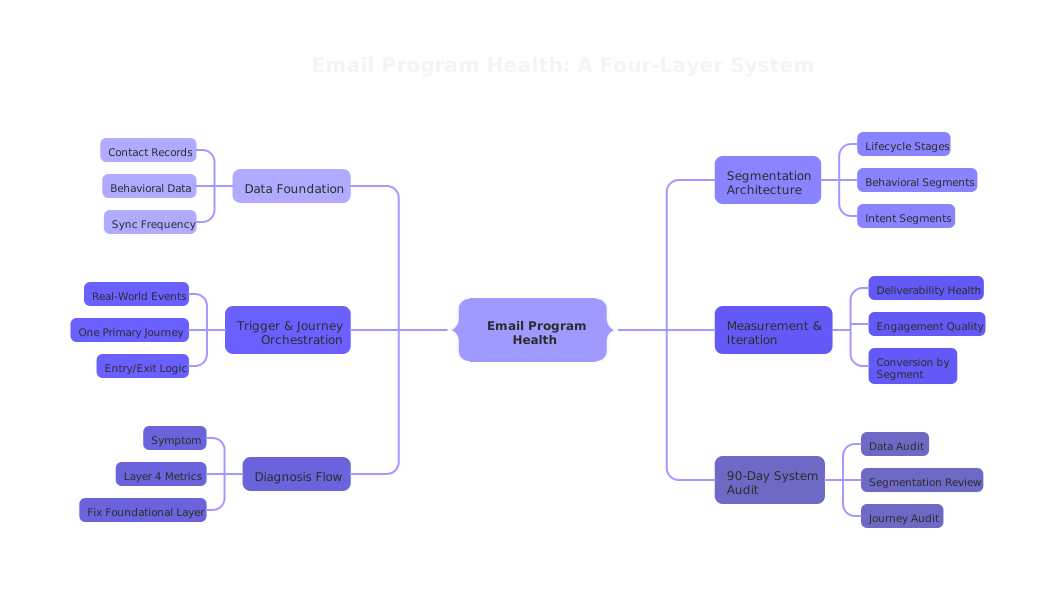
The Four Layers of a Systematic Email Program
Think of your email program as four layers stacked on top of each other. Each one depends on the layer below it. When something breaks, the problem usually lives two layers below where you are looking.
Layer 1: Data Foundation
This is the base. Everything else depends on it.
Your data foundation includes:
- Contact records and how they are structured
- Behavioral data from your website, product, and CRM
- How that data flows into your email platform
- How often it syncs and how clean it stays
A common problem here: a contact visits your pricing page three times, shows strong purchase intent, but your ESP does not know about it because the behavioral data lives in a separate analytics tool that never connects. You keep sending them top-of-funnel content. They buy from a competitor.
That is a data foundation failure. Not a creative failure.
What to check: Can your ESP see what a contact has done outside of email? Is that data updated in near real time, or days later? Are your contact records deduplicated, or do you have the same person in multiple segments at once?
Layer 2: Segmentation Architecture
Segmentation is not a one-time list split. It is an ongoing architecture that reflects where people actually are in their relationship with your business.
The mistake most programs make is building segments as static lists. You pull a list, send a campaign, move on. Meanwhile, that contact's situation has changed. They purchased. They churned. They referred a friend. Your segment does not know.
Effective segmentation is dynamic. It updates as behavior changes. It reflects both who someone is and what they have done recently.
Strong segmentation architecture includes:
- Lifecycle stage segments: Prospect, new customer, active customer, at-risk, lapsed
- Behavioral segments: Based on recent actions, purchase history, engagement patterns
- Intent segments: Built from content consumption, page visits, and search behavior
- Suppression logic: People who should not receive a campaign, not just people who should
That last one matters more than most people realize. Sending the wrong message to the wrong person at the wrong time does not just get ignored. It erodes trust.
Layer 3: Trigger and Journey Orchestration
This is where email marketing optimization and personalization actually comes to life.
A trigger is a real-world event that causes an email to send. Someone abandons a cart. A subscription is about to expire. A contact has not engaged in 60 days. These moments matter because they are specific and timely.
The problem is that most programs have triggers set up as individual automations, not as part of a coordinated journey. So a contact might simultaneously receive a win-back email, a promotional campaign, and an onboarding sequence. Three different parts of your program are talking to the same person with no awareness of each other.
This is orchestration failure. And it is more common than you think.
Good orchestration means:
- Contacts move through one primary journey at a time
- Entry and exit logic is explicit and intentional
- Triggers are connected to actual data, not just time delays
- Campaigns check for active journey membership before sending
One mid-size SaaS company we spoke with found that 22% of their promotional sends were going to contacts who were already inside a trial onboarding sequence. They were interrupting their own welcome experience with discount offers. Once they added suppression logic that checked for active journeys, their trial-to-paid conversion rate went up. The fix was not a new campaign. It was cleaning up the orchestration layer.
Layer 4: Measurement and Iteration
This layer gets the most attention and deserves it least at the start. You cannot optimize what you have not stabilized.
Still, once your data, segmentation, and orchestration are solid, measurement becomes powerful. Here is what to track:
- Deliverability health: Bounce rates, spam complaints, inbox placement
- Engagement quality: Not just open rate, but clicks per open, scroll depth if your platform supports it, reply rate for one-to-one sends
- Conversion by segment: Which segments are actually driving revenue, not just opens
- Journey completion rates: How many people who enter a sequence actually finish it
- Attribution: Where email sits in the path to purchase, not just last-click
The shift from tracking vanity metrics to tracking system health is one of the most important moves you can make. Open rate is easy to celebrate. Journey completion rate is what tells you if your system is actually working.
What Is Email Marketing Optimization and Personalization, Really?
People use these terms together so often that they blur into noise. Here is a clean way to think about them separately and together.
Optimization is the ongoing process of testing, measuring, and improving your email program. Subject line tests, send time experiments, layout changes. It is iterative and data-driven.
Personalization is the practice of using what you know about a contact to make an email more relevant to them specifically. That includes their name, yes. But more importantly, it includes their behavior, their lifecycle stage, their preferences, and their history with your business.
Email marketing optimization and personalization as a combined strategy means you are both continuously improving your program AND making each send more relevant to each person. One without the other leaves results on the table.
You can optimize a generic blast. You can personalize a single email. The real advantage comes when you have a system that does both, at scale, automatically.
The Most Common Execution Gaps (And How to Close Them)
After looking at how competitors in this space position their advice, a clear pattern shows up. Most content covers the what but skips the how. Here are the gaps most programs have and what to do about them.
Gap 1: Personalization that is only surface-level
Using first name and purchase history is table stakes now. The programs that stand out are using behavioral triggers to shift the entire message, not just the greeting. If someone has visited your help center three times in a week, they need a different email than someone who just made their first purchase. Build segments that detect these intent signals and route people accordingly.
Gap 2: Segments that never expire
A contact who bought from you 18 months ago is not the same as a contact who bought last week. Both might sit in a "customer" segment and get the same sends. Build segment logic that factors in recency. A customer who has not purchased in 12 months needs re-engagement, not your standard customer newsletter.
Gap 3: A/B testing without statistical discipline
Testing is good. Testing badly is a waste of time. The most common mistake is ending tests too early because a winner looks obvious. Give tests enough time and enough volume to produce a result you can trust. A subject line test on 200 contacts tells you almost nothing.
Gap 4: No feedback loop from sales or support
If your sales team is having a specific conversation with prospects, your email program should know about it. If customer support is seeing a spike in a particular question, a proactive email could address it. Most email programs operate in isolation from the rest of the business. Closing that loop is a competitive advantage.
Gap 5: Treating ESP as a sending tool, not a data platform
Modern email platforms can do much more than send. They can score contacts, track behavior, trigger workflows, and power personalization at scale. If you are using your ESP only to push sends out the door, you are paying for infrastructure you are not using.
A Practical Starting Point: The 90-Day System Audit
If you want to move from tactical to systematic, start with an honest audit before you change anything. Here is how to structure it.
Weeks 1 to 2: Data audit
- Map every data source feeding your ESP
- Identify what is syncing, how often, and what is not syncing at all
- Find your duplicate contact problem (every program has one)
Weeks 3 to 4: Segmentation review
- List every active segment
- Check how often each one updates
- Identify segments that overlap and contacts that appear in multiple active campaigns
Weeks 5 to 6: Journey and trigger audit
- List every active automation
- Map which contacts are currently inside each one
- Find orchestration conflicts where one contact is in multiple simultaneous journeys
Weeks 7 to 8: Measurement review
- Identify what you are actually measuring versus what you should be measuring
- Set up journey completion tracking if you do not have it
- Review attribution model and see where email sits in your revenue path
Weeks 9 to 12: Fix and stabilize
- Start with data fixes. They unlock everything else.
- Rebuild segmentation with dynamic logic
- Add suppression and entry/exit rules to orchestration
- Set a measurement baseline before running any optimization tests
This is not glamorous work. But it is the work that makes everything else produce better results.
How House of MarTech Approaches This
At House of MarTech, we look at email programs as systems, not campaigns. That means we start with the data layer, build toward segmentation and orchestration, and only then focus on optimization and testing.
Our approach to email marketing optimization and personalization is built for business owners who want a program that runs intelligently, not one that requires constant manual intervention. Whether you are on Klaviyo, HubSpot, Salesforce Marketing Cloud, or something else, the system principles are the same.
If you want a structured assessment of where your program has gaps, that is exactly the kind of work we do.
The Honest Bottom Line
Tactics are easy to find. They are everywhere. What most email programs are missing is a systematic foundation that makes the tactics work.
Fix the data. Build dynamic segmentation. Clean up your orchestration. Measure what actually matters.
That is the work. It is not flashy. But it is the difference between an email program that gets by and one that compounds your results over time.
If you want to talk through where your program stands, House of MarTech offers structured MarTech assessments built around exactly this kind of system-level thinking. No pressure. Just a clear look at what is working and what is not.
Start there.
Frequently Asked Questions
Get answers to common questions about this topic
Have more questions? We're here to help you succeed with your MarTech strategy. Get in touch
Related Articles
Need Help Implementing?
Get expert guidance on your MarTech strategy and implementation.
Get Free Audit